Why Karachi Struggles to Breathe
The emissions landscape in Karachi, as detailed in the preceding chapters, is shaped not only by sectoral activities but also by systemic, cross-cutting challenges. Several cross-cutting factors significantly influence emission levels across multiple sectors and present systemic challenges to effective air quality management. Addressing these underlying issues is paramount for the successful implementation of targeted mitigation strategies.
The Technology Gap
A significant factor contributing to Karachi’s emissions profile is the prevalent technology gap between current practices in Pakistan and established international best practices. This disparity is evident across several key areas:
Industrial production: Many industries in Karachi may rely on outdated production methods that are inherently less efficient and more polluting compared to modern, cleaner technologies available globally.
Vehicle fleet: The urban vehicle fleet, particularly in the heavy-duty diesel segment, is often characterized by older vehicles, predominantly adhering to pre-Euro III emission standards or even lower. These vehicles lack modern emission control technologies and contribute disproportionately to particulate matter and NOx emissions. This technological gap directly explains why the transportation sector is responsible for an overwhelming 80% of Karachi’s NOx emissions.
Waste management: Limited and outdated waste management infrastructure leads to practices such as open burning of municipal and industrial waste, a significant source of uncontrolled emissions.
This continued reliance on outdated technologies across sectors presents substantial opportunities for emission reductions through strategic modernization programs, technology transfer initiatives, and supportive policy frameworks that incentivize the adoption of cleaner and more efficient technologies.
The Fuel Problem
The quality of fuel available and used in Karachi, particularly diesel, poses a fundamental challenge to controlling emissions. Poor fuel quality, characterized by high sulfur content and other contaminants, significantly increases emissions of SO2 and particulate matter, even from vehicles or machinery that might otherwise be equipped with emission control technologies. This largely explains why power plants and industry emerged as Karachi’s top SO2 emitters.
The persistence of fuels with sulfur content reported to be 10 to 50 times higher than prevailing international standards severely limits the effectiveness of advanced emission control systems (which are often poisoned by high sulfur) and undermines efforts to improve air quality. Addressing fuel quality requires stringent regulatory standards, robust enforcement mechanisms to curb the sale of substandard and smuggled fuels, and investment in refinery upgrades to produce cleaner fuels domestically.
The Enforcement Gap
While Pakistan has established ambient air quality standards and some sector-specific emission limits, the capacity for effective and consistent regulatory enforcement remains severely limited. This “enforcement gap” allows many high-emitting activities to continue without adequate abatement measures.
Key limitations include:
Technical resources: Regulatory authorities often lack the requisite technical resources, including advanced monitoring equipment and skilled personnel, for continuous and comprehensive monitoring of emission sources.
Institutional capacity: The institutional capacity for consistent inspection, compliance verification, and imposition of penalties for non-compliance requires significant strengthening.
Without robust enforcement, even well-designed environmental regulations can fail to achieve their intended outcomes. Enhancing the technical capabilities, human resources, and legal authority of environmental protection agencies is crucial.
A Lack of Official Monitoring
The effective management of air quality is contingent upon the availability of reliable and comprehensive data. As demonstrated by the data gap analysis, which necessitates the use of robust third-party data from networks like PAQI, the regulatory air quality monitoring network remains inadequate, with no coverage across Sindh and significant gaps in continuous, real-time data collection for key pollutants. This deficiency complicates several aspects of air quality management:
Problem diagnosis: Accurate identification of pollution hotspots, understanding of temporal pollution dynamics, and assessment of public exposure are hampered by insufficient monitoring data.
Evaluation of interventions: The ability to scientifically evaluate the effectiveness of implemented mitigation policies and measures is compromised without a robust baseline and ongoing monitoring data.
Public information: Lack of accessible real-time data limits the ability to provide timely air quality information and health advisories to the public. Expanding the air quality monitoring network, ensuring data quality assurance and control (QA/QC), and making data publicly accessible are essential steps.
Fragmented Responsibilities
Air quality management in Karachi, as in many large metropolitan cities, involves responsibilities that are distributed among multiple federal, provincial, and municipal agencies. This fragmented governance structure, if not effectively coordinated, can lead to overlapping jurisdictions, policy inconsistencies, and gaps in accountability. Effective air quality management requires a cohesive, airshed-level approach that transcends administrative boundaries and ensures synergistic efforts among different government bodies, regulatory agencies, and other stakeholders. Establishing clear institutional mechanisms for inter-agency coordination, data sharing, and joint planning is vital for overcoming the challenges posed by fragmented governance.
Addressing these cross-cutting factors — technological gaps, fuel quality, enforcement limitations, data deficiencies, and fragmented governance — is not merely ancillary but fundamental to creating an enabling environment where sector-specific interventions can deliver sustained improvements in Karachi’s air quality.
| Standard / Region | Sulfur Content | Notes |
|---|---|---|
| Pakistan(Euro-II Standard) | 500 ppm | This is the most common standard for diesel produced by local refineries and has been in place since 2017. |
| Pakistan(Imported Euro-V) | 10 ppm | A higher-quality Euro-V diesel is available, primarily through imports, but it is not the universal standard across the country. |
| Euro-V Standard(International) | 10 ppm | This is the standard in Europe and many other developed economies, enabling advanced vehicle emission control technologies. |
| India(Bharat Stage VI) | 10 ppm | India leapfrogged to the stringent BS-VI standard (equivalent to Euro-VI) nationwide in 2020. |
Exhibit 11: Fuel Quality Gap: Sulfur Content in Diesel Fuel. This comparison highlights a critical systemic issue. The most common standard for diesel fuel in Pakistan (Euro-II, 500 ppm) allows 50 times more sulfur than modern international standards (Euro-V, 10 ppm) that are already in place in neighboring India and other regions. High-sulfur fuel significantly increases SO2 and PM2.5 emissions and damages vehicle emission control systems.
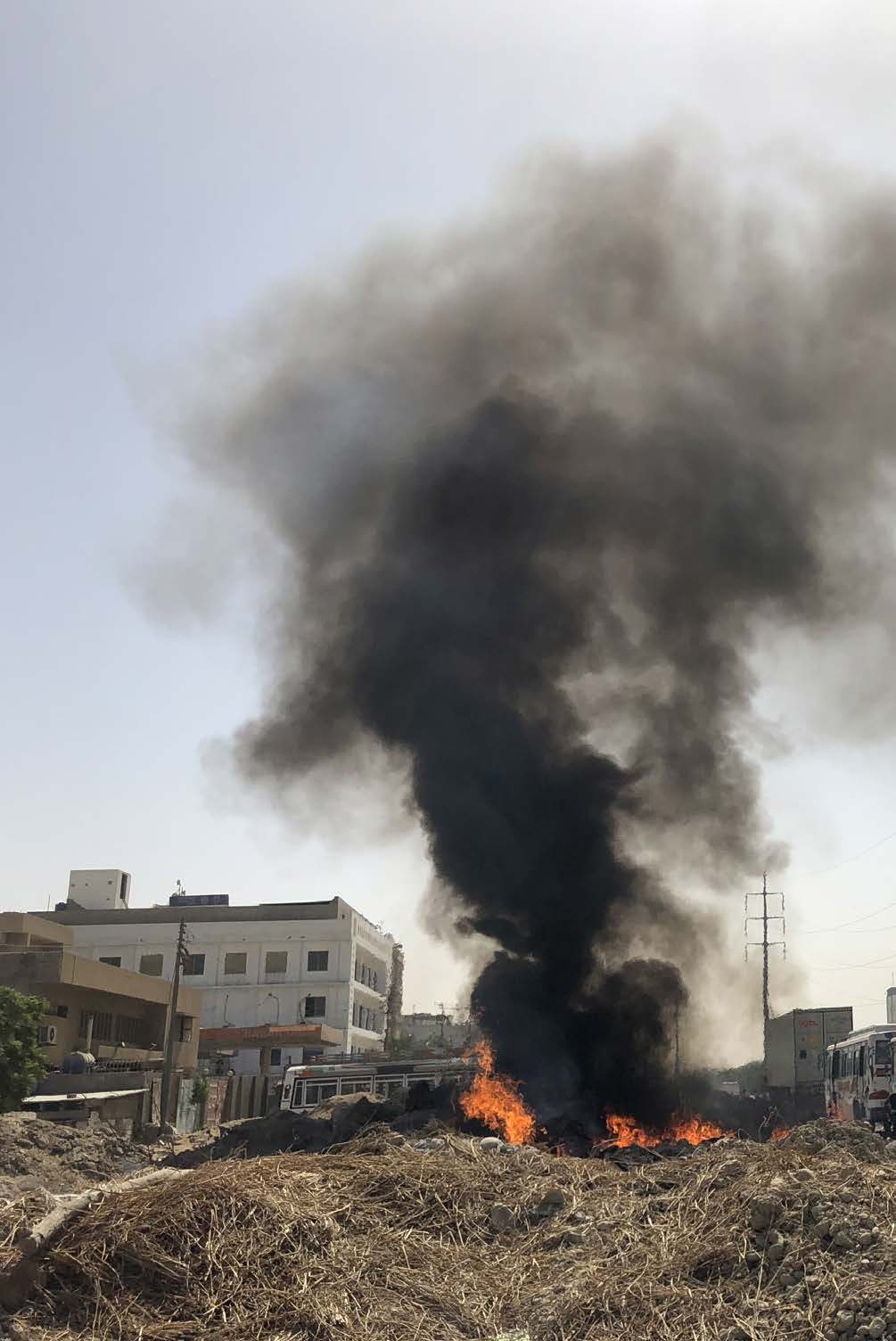
Karachi remains trapped in toxic air because the systems meant to protect us — regulation, enforcement, data — are broken or missing.
Mitigation Strategy
Karachi’s air pollution crisis is solvable with targeted, evidence-based action. Prioritized interventions in industry, transport, and port operations can slash harmful emissions by up to 50%, delivering major public health benefits.