Karachi’s Air Quality Crisis
The consequences of breathing polluted air are not abstract; they are measured in years of life lost. According to the Air Quality Life Index (AQLI), particulate pollution (PM2.5) reduces the life expectancy of an average resident of Pakistan by 3.3 years.1 For the citizens of Karachi, the cost is severe: an average resident could live 2.7 years longer if the city’s air quality was improved to meet the WHO’s health guideline.2
This local crisis is part of a global pollution pandemic. A 2022 report from the Lancet Commission on Pollution and Health found that pollution is responsible for approximately 9 million premature deaths globally each year — equivalent to one in every six deaths worldwide.3 The commission crucially notes that deaths from modern pollution sources like industrial emissions and ambient air pollution are increasing, having risen by 66% since 2000.
The Governance Gap in Air Quality Standards
To manage air quality, Pakistan has established National Environmental Quality Standards (NEQS),4 and Sindh has its own provincial standards (SEQS).5 A significant gap exists between these regulatory limits and the guidelines recommended by the World Health Organization (WHO) based on the latest health evidence. This disparity means that even on a day when Karachi’s air is considered “acceptable” by regulatory standards, it remains above safe limits for health.
WHO provides a series of Interim Targets as a roadmap for heavily polluted regions to make incremental progress. Good governance practice suggests that once a standard aligned with an interim target is consistently met, policymakers should aim for the next, more stringent target. As Exhibit 1 shows, Sindh’s annual PM2.5 standard of 40 µg/m³ is weaker than even the most lenient WHO Interim Target 1 of 35 µg/m³, placing it far from the health-based guideline of 5 µg/m³.
| Pollutant | NEQS 2010 | NEQS 2013 | SEQS 2016 | WHO 2005 | WHO 2021 |
|---|---|---|---|---|---|
| SPM | 400 | 360 | 360 | N/A | N/A |
| SO2 | 80 | 80 | 80 | N/A | N/A |
| PM2.5 | 25 | 15 | 40 | 10 | 5 |
| PM10 | 200 | 120 | 120 | 20 | 15 |
| NO2 | 40 | 40 | 40 | 40 | 10 |
| NO | 40 | 40 | 40 | N/A | N/A |
| Lead (Pb) | 2 | 1 | 1 | 1 | 1 |
Karachi’s Chronic Air Pollution Problem
Measurements from the PAQI air quality monitoring network reveal that the air quality in Karachi consistently fails to meet Sindh Environmental Quality Standards (SEQS) for ambient air. Exhibit 2 shows that the annual average PM2.5 concentration in Karachi has failed to meet the SEQS limit of 40 µg/m³ in six of the last eight years. Every year, the annual average has remained dangerously high — between 7 and 11 times WHO’s guideline value for the safe limit.
The daily data reveals the constant health risk. In 2024, only three days in the entire year met WHO’s guideline for clean air. For the remaining 363 days, the air was unhealthy by global standards. Critically, on 70 of those days, air pollution was so severe that it exceeded Sindh’s own legal 24-hour limit of 75 µg/m³.
From Diagnosis to Action
Karachi faces a severe and persistent air pollution crisis that shortens lives and consistently exceeds both local and global standards. This data tells us what the problem is and how bad it is.
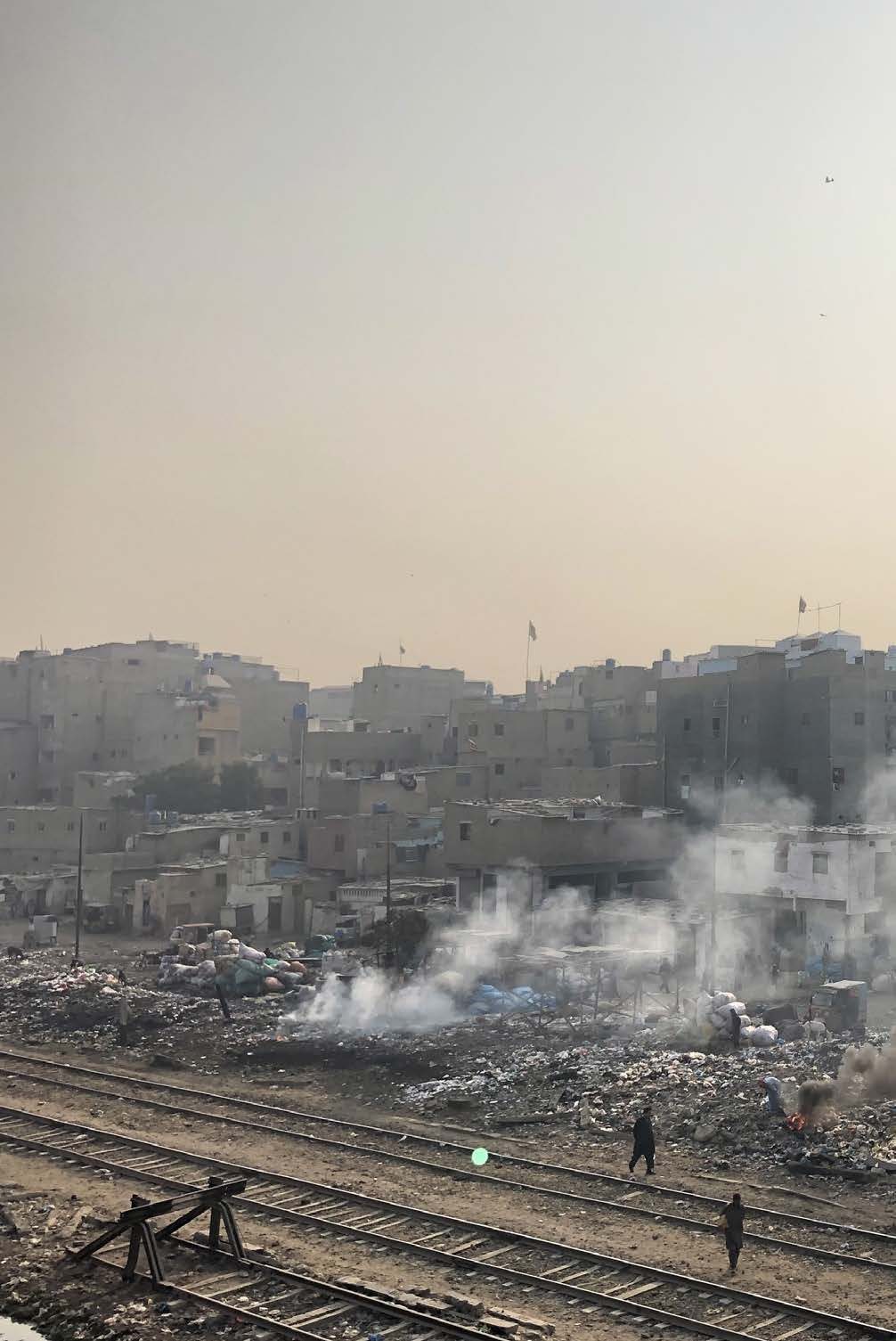
To craft effective solutions, we must now understand why. The emissions inventory detailed in the following chapters provides that critical diagnosis by identifying the sources of this pollution. Only by knowing the sources can Karachi forge an evidence-based path towards a healthier, breathable future.
Scope and Rationale
Karachi’s severe air pollution demands urgent, informed action rooted in evidence. This first scientific emissions inventory provides the critical data needed to diagnose the sources and forge effective, evidence-based solutions for cleaner air.